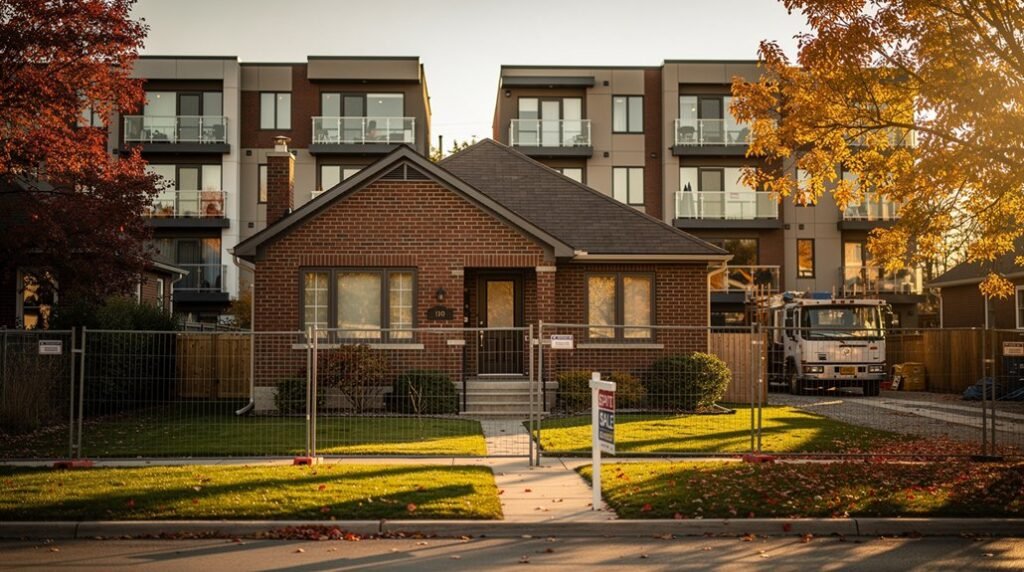

Your North York home sale qualifies for a principal residence exemption if you’ve ordinarily inhabited the property, eliminating capital gains tax entirely. You must report the sale on Schedule 3 to maintain eligibility. Secondary properties face Canada’s two-tier capital gains structure: 50% inclusion rate on the first $250,000 annually, jumping to 66.67% above that threshold starting January 1, 2026. Co-ownership with your spouse can split gains to stay under $250,000 each. Strategic timing and proper designation prevent six-figure tax bills most homeowners never see coming.
Key Takeaways
- Your primary residence is exempt from capital gains tax if you owned and ordinarily inhabited the property during ownership.
- Only one property per family unit can qualify for the principal residence exemption each year.
- Secondary properties like cottages face full capital gains taxation without exemption benefits at the new rates.
- Capital gains up to $250,000 are taxed at 50% inclusion rate; amounts above face 66.67% inclusion rate.
- Report your sale on Schedule 3 of your T1 Tax Return to maintain eligibility for the exemption.
Capital Gains on Your North York Home: The Principal Residence Exemption

The principal residence exemption eliminates capital gains tax on your primary home’s sale. To qualify, you must meet specific Income Tax Act criteria.
Ownership and Occupancy Requirements
You need to own the property alone or jointly. The property must be “ordinarily inhabited” by you, your spouse, common-law partner, or children during the calendar year. Short-term occupancy counts—even vacation properties qualify.
Ordinary inhabitation doesn’t require year-round residency—brief occupancy periods satisfy ownership requirements for primary residence designation.
Eligible Property Types
- Detached and semi-detached houses
- Condominiums and townhouses
- Cottages (despite seasonal use)
- Mobile homes and houseboats
Land cannot exceed one-half hectare (1.2 acres) in most cases. However, excess land may qualify if necessary for the property’s use and enjoyment.
Critical Limitation
Only one property per family unit receives exemption status annually. Your family unit includes your spouse or common-law partner and minor children. If you own multiple properties simultaneously, you’ll designate one property per tax year at sale. You must report the sale on Schedule 3 of your T1 Tax Return to maintain your exemption eligibility.
This designation carries significant long-term tax consequences for secondary properties.
Calculating Your Capital Gains Tax: the 50% Vs 66.67% Rate Structure
Canada’s 2026 capital gains tax structure operates on a two-tier system that directly affects how you’ll calculate taxes on investment properties or secondary homes in North York. You’ll pay tax on 50% of your capital gains up to $250,000 annually, but any gains exceeding that threshold face a steeper 66.7% inclusion rate. Corporations and most trusts don’t get this $250,000 buffer—they’re stuck with the higher rate from dollar one. To calculate your actual tax liability, you’ll multiply your taxable capital gain by your marginal income tax rate, which varies based on your total income. The implementation of these rate changes was deferred to January 1, 2026, giving taxpayers additional time to plan their real estate transactions and investment strategies.
Understanding the $250,000 Threshold
Starting January 1, 2026, individual taxpayers will face a two-tiered capital gains inclusion rate structure tied to a $250,000 annual threshold.
How the threshold works:
- First $250,000 of net capital gains: 50% inclusion rate
- Gains exceeding $250,000: 66.67% inclusion rate
- Threshold applies to combined capital gains and employee stock options
- Full $250,000 available annually without proration
Key limitations:
Corporations and trusts don’t receive this threshold. They’ll pay 66.67% on all net gains starting 2026.
Calculation method:
You’ll calculate gains before and after January 1, 2026, separately. Net gains offset losses across periods when determining threshold application. Transitional rules will require you to separately identify capital gains and losses realized before and after the effective date.
Strategic consideration:
Co-ownership splits gains between owners. If each owner’s portion stays under $250,000, you’ll avoid the higher rate entirely—a planning opportunity worth exploring. For capital dispositions occurring before January 1, 2026, the inclusion rate remains at 50% regardless of the amount.
Corporations Pay Higher Rates
While individual homeowners navigate the $250,000 threshold, corporations and trusts face a blunt reality: they don’t get one.
Current Inclusion Rates:
- 2025: Capital gains taxed at 50% inclusion rate
- January 1, 2026: Rate jumps to 66.67% for all corporate gains
- No threshold exemption exists for incorporated entities
Tax Impact Comparison:
A $100,000 capital gain produces vastly different liabilities:
*At 50% inclusion (2025):*
- Taxable amount: $50,000
- Federal tax at 38%: $19,000
At 66.67% inclusion (2026):
- Taxable amount: $66,670
- Federal tax at 38%: $25,335
- Increase: 33% higher tax on identical gain
Provincial rates compound this burden. Ontario’s combined investment income rate reaches 51.5% before inclusion adjustments. The federal rate on investment income of Canadian-controlled private corporations stands at 38⅔% before provincial taxes apply.
You’ll face no threshold relief—corporations pay the full rate on every dollar gained. Headline corporate capital gains are generally subject to the normal CIT rate structure, making timing critical for minimizing tax exposure.
When Secondary Properties and Cottages Trigger Capital Gains Tax

Owning a cottage or secondary property in North York sets you up for capital gains tax when you sell. Unlike your primary home, these properties don’t qualify for the principal residence exemption. You’ll face full taxation on the gain increase.
Here’s what triggers the tax:
- No exemption applies – Vacation homes and cottages can’t claim principal residence status unless you designate them for specific ownership years
- Full gain gets taxed – Calculate your gain by subtracting purchase price plus renovations from selling price, then apply inclusion rates
- 2024 rates matter – The first $250,000 of gains faces 50% inclusion rate; amounts exceeding that jump to 66.67%
Co-ownership offers a strategic advantage. Splitting gains between partners keeps each person’s share under the $250,000 threshold. Track all costs meticulously—your adjusted cost base includes purchase price, renovations, and acquisition expenses. These deductions minimize your taxable gain when you sell. You can also deduct real estate commissions and other selling expenses from your capital gain calculation. Remember that capital gains represent an increase in asset value, so only the profit portion from appreciation gets taxed, not your original investment.
The $250,000 Capital Gains Threshold: Why Timing Your Sale Matters
The federal government pushed the capital gains inclusion rate change to January 1, 2026.
What’s changing:
- Your first $250,000 in annual capital gains stays at 50% inclusion rate
- Amounts above $250,000 jump to 66.67% inclusion rate
- All gains within the same tax year combine toward your threshold
Why timing matters for North York secondary properties:
If you sell your cottage in 2025, you’ll pay tax on 50% of the entire gain. Wait until 2026, and you’re splitting calculations—half on the first $250,000, two-thirds on the rest.
The couple advantage:
Married partners selling jointly can each claim the $250,000 threshold. A $500,000 combined gain gets taxed entirely at the lower rate if properly structured.
2024 and 2025 sales won’t trigger the increased rate. The CRA stopped administering changes as if they’d started in June 2024.
Splitting Gains Between Spouses to Stay Under the $250,000 Threshold
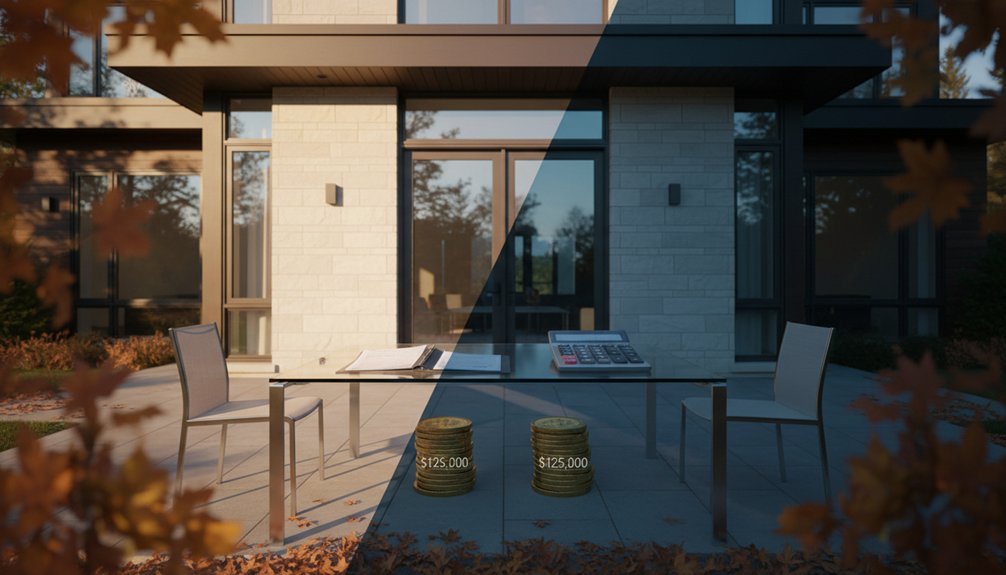
If you own a North York investment property jointly with your spouse, you’re likely paying more tax than necessary. The solution involves splitting the $500,000 gain between you and your spouse.
Each spouse gets their own $250,000 capital gains allowance. That’s a combined $500,000 at the favorable 1/2 inclusion rate. Beyond this threshold, you’ll pay tax on 2/3 of the gain instead.
Here’s how the strategy works:
- Elect out of the automatic spousal rollover when transferring half the property at fair market value
- Trigger immediate gain recognition at the time of transfer, not later sale
- File a joint election with your tax return to avoid attribution rules
A $500,000 gain costs $156,000 when held by one spouse. Split between two spouses, it costs $134,000. You’ll save $22,000 in taxes—money that stays in your pocket instead of going to CRA.
The Entrepreneurs’ Incentive: Lower Taxes on Business Property Sales
If you’re selling qualified small business shares or farm property in 2025, you’ll access a new capital gains incentive. The Canadian Entrepreneurs’ Incentive reduces your inclusion rate to 33.33% on eligible gains up to $2 million over five years. You can stack this relief with your $1.25 million Lifetime Capital Gains Exemption for combined shelter reaching $3.25 million by 2029.
Incentive Structure and Timeline
Starting January 1, 2025, Canada’s new Canadian Entrepreneurs’ Incentive (CEI) reduces the capital gains inclusion rate to 33.3% on qualifying business dispositions, applying to gains up to $2 million over your lifetime.
The rollout follows a phased timeline extending to 2034:
- 2025-2029: Annual limit increases by $400,000 yearly, reaching the initial milestone
- 2030-2034: Additional $200,000 annual increases until the full $2 million cap becomes available
- By 2034: Complete $2 million lifetime maximum accessible for eligible entrepreneurs
Combined with the Lifetime Capital Gains Exemption, you’ll access up to $3.25 million in total exemptions when fully implemented. This graduated approach allows strategic planning for future business sales. The legislation remains draft status, subject to parliamentary approval and potential modifications before final enactment.
Combining Multiple Tax Exemptions
Two complementary federal programs stack together to maximize your tax savings on qualifying business sales.
How the Programs Combine:
The Lifetime Capital Gains Exemption (LCGE) applies first, sheltering up to $1.25 million in gains. After LCGE deduction, the Canadian Entrepreneurs’ Incentive (CEI) then reduces your inclusion rate on an additional $2 million.
Maximum Combined Benefit:
When fully implemented, you’ll access $3.25 million in total exemptions. Here’s a practical example: A $1 million qualifying gain results in just $325,000 taxable income. You’d claim an $833,333 LCGE deduction, then a $133,333 CEI deduction.
The Calculation Sequence:
- Apply LCGE to shelter initial gains
- Apply CEI’s reduced inclusion rate to remaining eligible amounts
- Calculate tax on substantially reduced taxable portion
This stacking mechanism specifically benefits business owners disposing of qualifying shares or farm property.
Does Your Farm Qualify for the Lifetime Capital Gains Exemption?

Understanding whether your farm qualifies for the Lifetime Capital Gains Exemption requires meeting several strict criteria. Your property must include real estate, buildings, land, or shares in family farm corporations actively used in farming operations. You’ll need to prove active engagement on a regular, continuous basis.
Qualifying for the farm capital gains exemption demands strict proof of active, continuous farming operations and proper asset classification.
The gross revenue test is straightforward. Your farming income must exceed total income from all other sources. For properties purchased after June 18, 1987, you’ll need two years meeting this threshold. This prevents investment properties from qualifying.
Key ownership requirements include:
- Minimum two-year ownership before disposition to demonstrate sustained commitment
- Active use requirement – frequent rental arrangements disqualify your property
- Pre-1987 purchases need farming use in five years during ownership or the disposition year
The exemption allows up to $1 million in tax-free capital gains. Only 50% of gains are taxable, substantially reducing your tax burden on qualifying farm dispositions.
Missing the Principal Residence Designation: A $200,000 Error
Forgetting to designate your principal residence on your tax return transforms what should be a tax-free sale into a costly mistake. You’ll face a taxable capital gain on the portion the exemption should’ve covered.
How the Error Occurs:
- You sell your home but don’t complete Schedule 3 or form T2091
- You fail to report the disposition in the sale year
- The principal residence designation never appears on your return
Financial Impact:
The $200,000 figure isn’t hypothetical. Without designation, the formula in subparagraph 40(2)(b) of the Income Tax Act calculates your gain without exemption. Half becomes taxable income at your marginal rate.
No Second Chances:
Retroactive correction isn’t available once deadlines pass. You can’t fix a missed election years later.
Mandatory Requirements:
You must designate on your tax return for the exemption to apply. Ownership plus habitation during the year aren’t enough alone. The designation itself triggers protection.
Should You Sell Before 2026 or Wait Until 2027?

Beyond designation errors, you’ll face a different calculation starting January 1, 2026. The inclusion rate increases from 50% to 66.67% on gains exceeding $250,000 annually for individuals. Corporations and most trusts lose the threshold protection entirely.
Here’s what timing means for your secondary property:
- Gains under $250,000 remain taxed at 50% regardless of when you sell—no rush needed for modest appreciation
- Individual gains of $300,000 trigger 66.67% inclusion only on the $50,000 excess, protecting the first $250,000 at 50%
- Joint ownership with your spouse creates $500,000 of combined threshold room, shielding substantial gains from higher taxation
The deferral extends this deadline through December 31, 2026. You’ve got breathing room to assess your property’s appreciation. A cottage worth $400,000 above purchase price faces identical treatment whether sold in 2026 or 2027 if owned jointly. Principal residences remain fully exempt under all scenarios.
Conclusion
You’ve got the facts now. The principal residence exemption shields your North York home from capital gains tax. Secondary properties don’t get this break. The $250,000 threshold matters if you’re selling before 2026—after that, the 66.67% inclusion rate hits harder. Designate your principal residence correctly. Split gains with your spouse when possible. Time your sale strategically. These aren’t suggestions—they’re expensive mistakes you can’t afford to make.