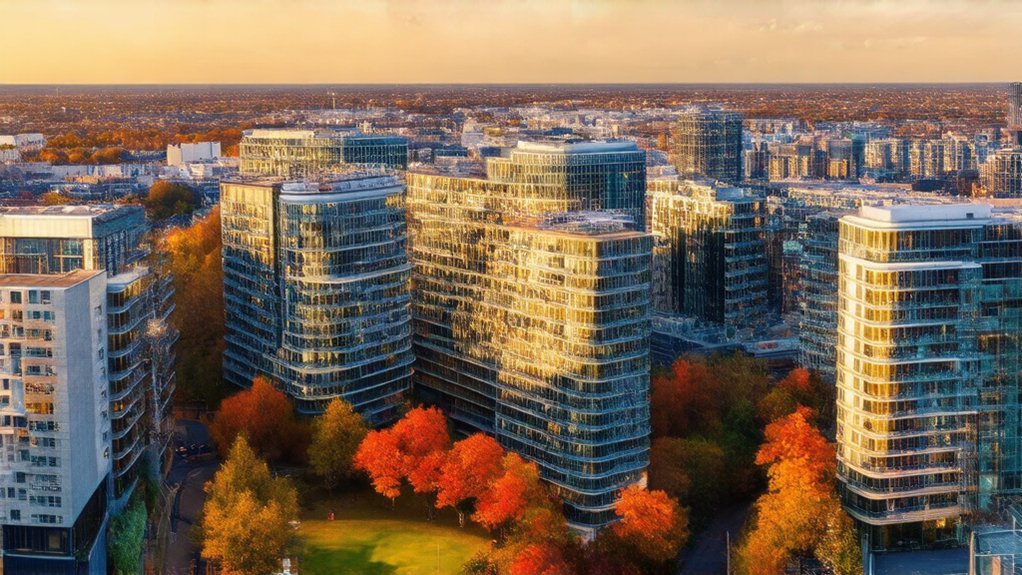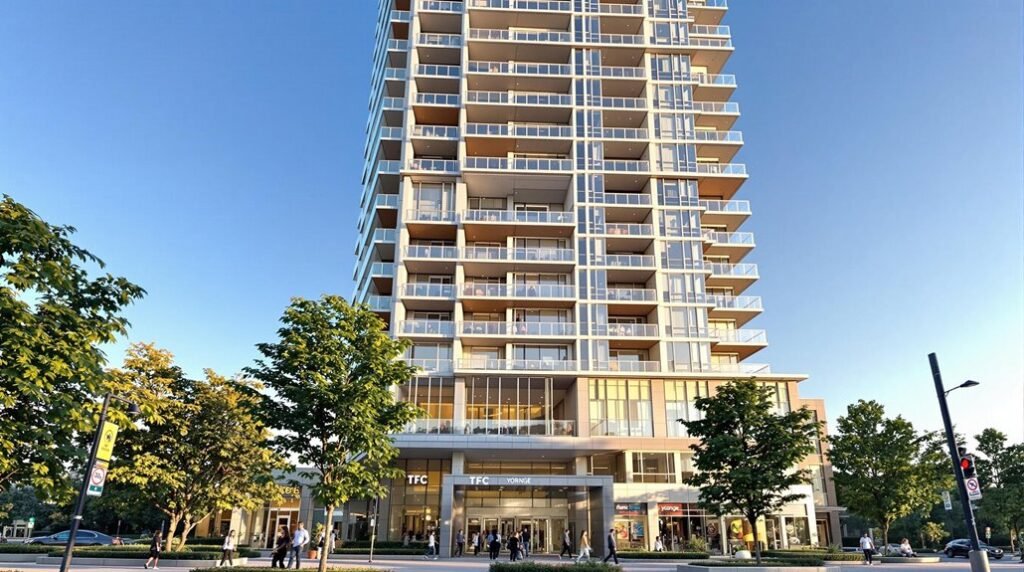
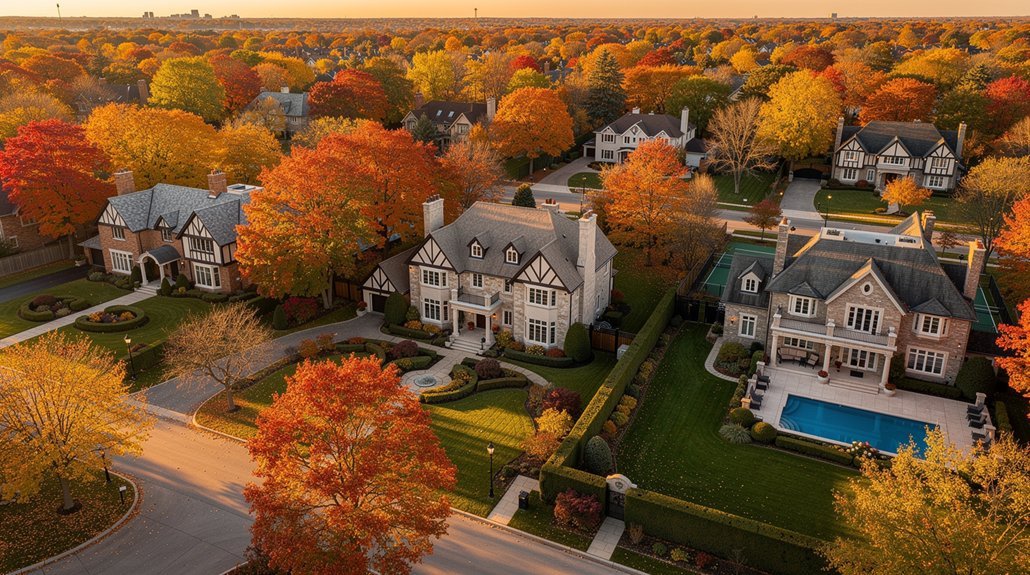
York Mills’ “Golden Triangle” holds value because you’re buying into century-old planning that locked in spacious lots before density pressures arrived. The 1856 subdivision stayed undeveloped until 1911, when grand residences replaced industrial sites on larger parcels than modern zoning allows. Highway 401 access arrived in 1952-1956, followed by the York Mills subway station in 1974, adding infrastructure without sacrificing the low-density character that affluent buyers originally sought. The combination of historical lot sizes and modern connectivity creates conditions that sustain premium pricing across market cycles.
Key Takeaways
- Historic development beginning in 1911 established prestigious residences with character that affluent buyers actively sought and valued.
- Century-long patient development created spacious lots and established strong property values through selective, gradual growth.
- Edwards Gardens development in 1944 and donated parkland added significant green space amenities enhancing neighborhood desirability.
- Highway 401 completion in the 1950s and York Mills subway station opening in 1974 provided excellent transportation connectivity.
- Combination of historical prestige, generous lot sizes, parkland access, and modern infrastructure sustains long-term property values.
What Defines the York Mills Golden Triangle: and Why It Matters for Property Values?
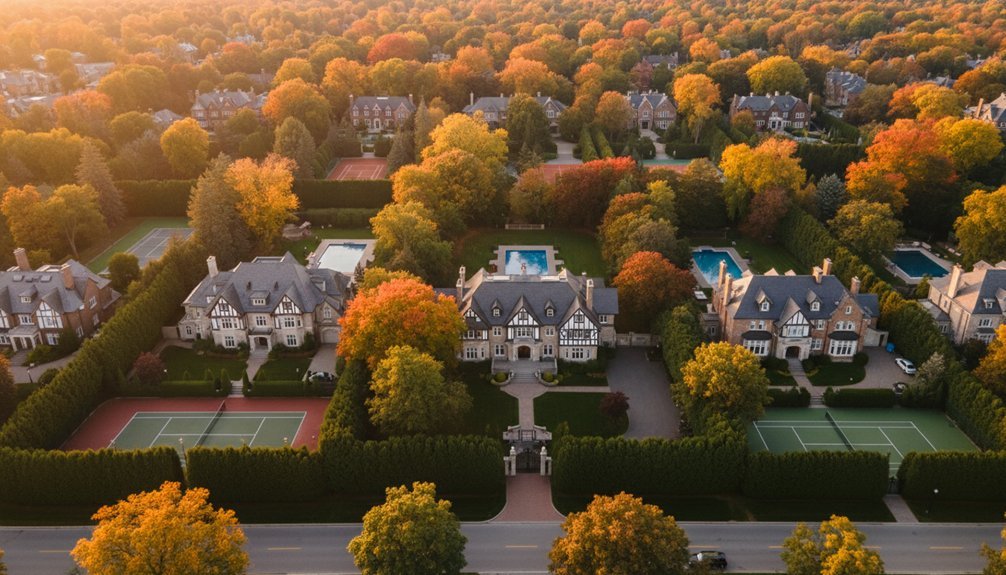
While most Toronto neighborhoods blend into adjacent communities, York Mills occupies a precisely defined quadrilateral.
The Four-Wall Boundary System
Your property sits within hard geographic limits:
- Highway 401 caps the north
- Leslie Street closes the east
- York Mills Road seals the south
- Yonge Street anchors the west
This creates containment. Limited geography means restricted supply.
Why Boundaries Drive Value
The quadrilateral encompasses Canada’s fourth and seventh most affluent postal codes as of 2010. You’re buying into scarcity. When developers can’t expand outward, existing homes appreciate faster.
The area earned “millionaires’ mile” status alongside Bridle Path, Forest Hill, and Rosedale. That’s not marketing language—it’s postal code data.
The Practical Impact
Protected greenery prevents density increases. The plateau terrain from Yonge to Bayview Avenue maintains visual consistency. You won’t see sudden zoning changes or high-rise conversions disrupting property values. The borders hold firm.
North York became a city on February 14, 1979, and this administrative evolution strengthened local governance structures that now protect established residential zones. The Official Plan offers additional protection by not anticipating future development in the neighborhood. This creates containment. Limited geography means restricted supply.
Current Home Prices in the York Mills Golden Triangle: What Buyers Pay in 2025
York Mills homes averaged $2,931,389 in 2025. You’ll find significant price variations by property type.
Price Breakdown by Home Type:
- Detached houses: $3,626,312 average
- Condos: $901,123 average
- Detached homes represent 72% of sales
- Condos account for 14% of transactions
Current Luxury Listings:
The high end shows considerable range. A 7-bedroom property lists at $7,800,000. Another 7-bedroom home asks $6,880,000. You’ll see a 6-bedroom at $4,598,000.
Mid-Range Golden Triangle Properties:
Five-bedroom homes vary substantially. One at 1 Silvergrove Rd lists for $6,298,888. Another at 130 York Mills Rd asks $3,200,888. A property at 39 Harrison Rd sits at $3,000,000.
Market Reality:
Most homes sell at or above asking price. Demand consistently outpaces supply. Detached properties price well above Toronto’s average—a pattern that’s held for years. Properties typically spend just 11 days on market before going pending. Condo townhouses make up 11% of home sales, offering an alternative to traditional detached houses.
Earl Haig and York Mills Collegiate: The School Rankings Driving Family Demand
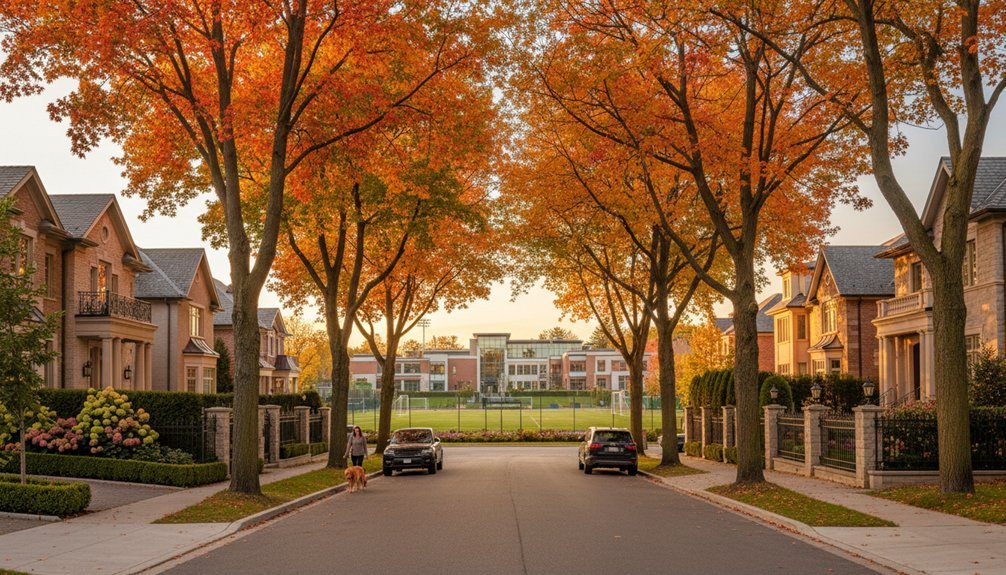
You’re paying for access to schools that consistently rank in Ontario’s top 25. York Mills Collegiate holds a 9.0 Fraser Institute rating—placing it 23rd out of 260 schools province-wide with a 91st percentile five-year average. Homes within these catchment boundaries command premiums of 15-20% over comparable properties just blocks outside the enrollment zones. These schools stand out for their strong pathways to post-secondary success and access to specialized academic streams like International Baccalaureate and Advanced Placement programs. Even during market corrections, neighborhoods anchored by top-performing schools see less pricing volatility and faster recovery when buyer demand returns.
Top-Tier Academic Performance Rankings
Two internationally-ranked public secondary schools anchor York Mills’ reputation as North York’s premier family destination.
Earl Haig Secondary School
- Fraser Institute rating: 8.9/10 (2025)
- Provincial rank: 23rd among Ontario secondary schools
- Overall grade: 8.8/10, placing 28th of 746 schools
- Learning Opportunities Index: 96-100 across all metrics
- Offers the Claude Watson Arts Program for enriched art education alongside its Collegiate Program
York Mills Collegiate Institute
- Fraser Institute rating: 9.0/10 (2025)
- Learning Opportunities Index: 97-104 range (2023)
- Consistently ranked top 100 Ontario high schools
Both institutions drive Fraser rankings through Grade 9 math proficiency, OSSLT results, and outcome consistency. EQAO data determines these ratings directly.
You’ll find university acceptance rates exceed 90% at comparable top-tier schools. Families planning decade-ahead education strategies create sustained luxury property demand. The latest provincewide test results from 2023-24 inform these academic indicators and school performance comparisons. Low turnover rates follow predictably.
Proximity Premium on Properties
A Fraser Institute rating above 9.0 translates into predictable real estate premiums within school catchment boundaries. York Mills Collegiate Institute‘s 9.0 rating anchors one of Toronto’s most stable luxury pockets, where low turnover defines buyer behaviour. Properties in York Mills, Windfields, and Bridle Path command premium pricing specifically because of catchment area positioning.
Earl Haig Secondary School’s 8.9 rating creates measurable demand in Willowdale East, where families balance school quality against more accessible price points. The school serves over 2,000 students and ranks 28th among 746 Ontario secondary schools.
You’ll notice strategic buyers sometimes purchase in adjacent North York neighbourhoods to avoid overpaying within specific catchment boundaries. School boundaries effectively create real estate micro-markets with distinct pricing characteristics that persist across market cycles.
Ravine Lots and Don Valley Trails: The Green Space Premium
When you’re evaluating York Mills real estate, ravine lots represent the market’s most protected investment. The Ravine development demonstrates this premium through concrete numbers: 13 acres of ravine land supporting 1,600 units, with two acres permanently designated as conservation space. Initial pricing ranged from $267,900 to $478,900, reflecting green space valuation.
A comparable ravine lot sold for $3,280,000 with $11,327 in annual taxes. That’s not speculation—it’s scarcity economics. Environmental regulations prevent future ravine development, capping supply permanently.
You’ll access walking paths throughout the conservation land and connect to Don Valley trails without leaving the property. These aren’t decorative features. Trail access and preserved green corridors create measurable value retention that standard urban condos can’t replicate. The building’s concierge and gym complement the outdoor amenities, providing year-round lifestyle options that enhance property appeal.
Current low unit availability at The Ravine confirms sustained demand. The 29-storey tower completed in 2021 now anchors this conservation-adjacent location with proven delivery and occupancy. When natural amenities are irreplaceable, appreciation typically outpaces conventional properties. The Don Valley view isn’t just scenery—it’s structural protection against value erosion.
Highway 401 and TTC Access: Why Commuters Pay More Here
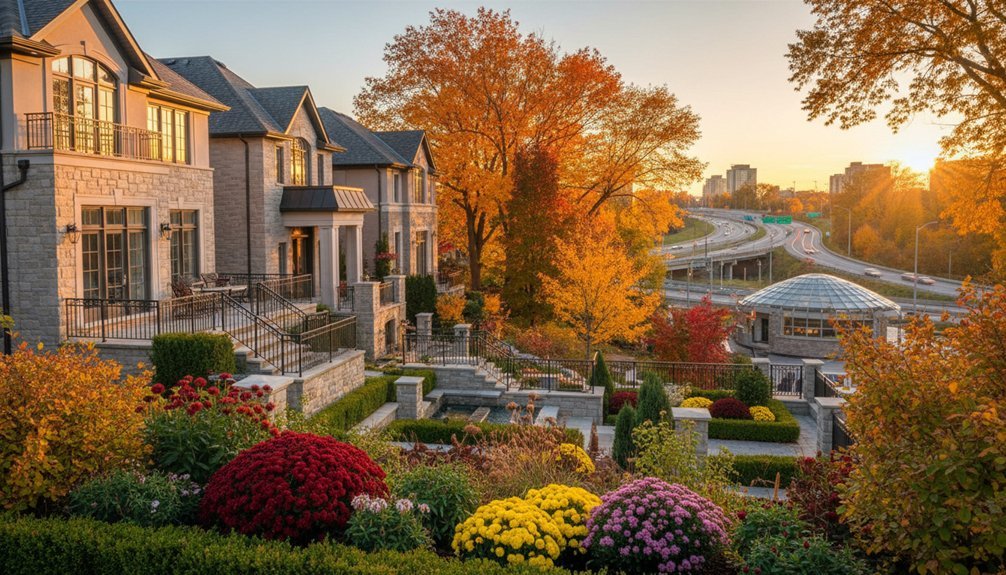
Highway 401 carries 50% of Toronto’s GDP—$58 billion annually—directly past York Mills properties. You’re paying for more than location. You’re buying time back.
Why the premium exists:
- TTC subway at Yonge-401 puts downtown 20 minutes away by train.
- Highway 400-401 interchange sits less than 1 km west—regional connectivity matters.
- Highway 413 cuts 30 minutes off York Region trips when complete.
- Bradford Bypass saves 22 minutes on east-west routes through the area.
Properties like 2090 Jane Street get 625 feet of Highway 401 visibility. That exposure translates to commercial reuse potential and higher resale values.
Gridlock costs $58 billion in lost productivity. York Mills addresses that. The development pipeline includes 13,750 residential units near transit hubs—demand isn’t slowing.
You’ll pay more upfront. But reduced congestion saves $273 million economically across the corridor. Commuters calculate that premium differently when they’re not sitting in traffic.
How Frozen Inventory (Under 40 Listings) Keeps York Mills Prices Stable
When York Mills holds fewer than 40 active listings, you’re watching a supply squeeze that fundamentally alters buyer behavior. This inventory freeze—contrasted sharply with York Region’s 31,272 total listings in 2025—creates bidding wars on well-positioned properties and hands sellers pricing power most GTA neighbourhoods haven’t seen since 2021. The result: your competition intensifies while sellers dictate terms, not prices.
Supply-Demand Imbalance Effects
Why does York Mills maintain price stability while the broader GTA experiences corrections? The answer lies in structural supply-demand mechanics.
Core Imbalance Drivers:
- Inventory Constraint — Under 40 active listings create scarcity pricing.
- Demand Concentration — York Mills Collegiate’s 9.0 rating anchors buyer interest.
- Months of Inventory — York Mills stays below 4 months (seller’s market threshold).
The GTA shows 7+ months supply in many areas. York Mills avoids this oversupply. Finite school catchments limit new inventory entering the market. Sellers hold firmer on pricing because replacement properties are scarce.
Market Contrast:
- GTA benchmark: Down 4.6% year-over-year
- York Mills median: $1,711,450 in December 2025
This imbalance sustains premium pricing. You’re witnessing classic supply restriction economics in action.
Bidding War Frequency
Supply constraints create predictable buyer behavior patterns. When inventory drops under 40 listings, you’ll see multiple offers resurface despite broader GTA cooling. York Mills maintains 2.5-3.5 months of inventory—well under the 4-month seller’s market threshold.
Competition triggers include:
- Fast absorption rates that empty available stock within weeks
- School catchment urgency around York Mills CI driving immediate decisions
- Luxury pocket scarcity forcing buyers to act on rare listings
December 2025 saw just 18 median sales, yet bidding wars emerged on properly priced homes. This contrasts sharply with York Region’s 31,272 listings (up 13.9%) and Toronto’s 25,893 condo units sitting idle.
Limited turnover means every new listing attracts accumulated demand. You’re competing against buyers who’ve waited months for inventory.
Seller Market Power
How does inventory scarcity translate into concrete seller advantages?
York Mills maintains seller control through:
- Active listings frozen under 40 units — restricting buyer choice
- Sales-to-new-listings ratio at 70% — indicating seller-leaning conditions
- Detached houses at 79% of sales — limiting inventory diversity further
You’ll find sellers hold firmer on pricing here. When broader GTA listings jumped 35% year-over-year, York Mills stayed tight. The neighbourhood’s 9.0-rated York Mills CI anchors long-term ownership patterns.
Price floors emerge from scarcity:
- GTA benchmark dropped 4.6% to $1,068,700
- York Region fell 6.5% to $1,229,218
- York Mills luxury pocket resists broader corrections
Under 4 months of inventory signals persistent seller power. Priced-right homes absorb quickly while mispriced listings languish past 100 days.
York Mills Price Growth: 150% Appreciation Over 15 Years
Over the past fifteen years, York Mills has delivered exceptional returns that few Toronto neighbourhoods can match. The data tells a compelling story of sustained value growth.
York Mills stands among Toronto’s elite performers, with fifteen years of data proving exceptional and sustained property value appreciation.
Key appreciation metrics include:
- Condos gained 74.24% over five years—second-highest among analyzed Toronto areas.
- Single-family homes rose modestly at 3.43% despite premium baseline pricing.
- The neighbourhood’s “millionaire’s mile” prestige drove gains in expensive segments.
Recent performance shows continued strength. Detached home sales jumped 20.6% year-over-year in early 2020. Seventy-six homes sold versus sixty-three the prior year. The district ranked second in the 416 area for sales increases.
Nearby Donalda saw prices surge 53% to $2,394,400 median in 2021. York Region detached sales soared nearly 110% year-to-date during the same period.
Low inventory—just one to four months of supply—fueled these gains. Nearly half of sixty TRREB districts posted over 25% annual price increases.
How York Mills Golden Triangle Compares to Rosedale and Forest Hill
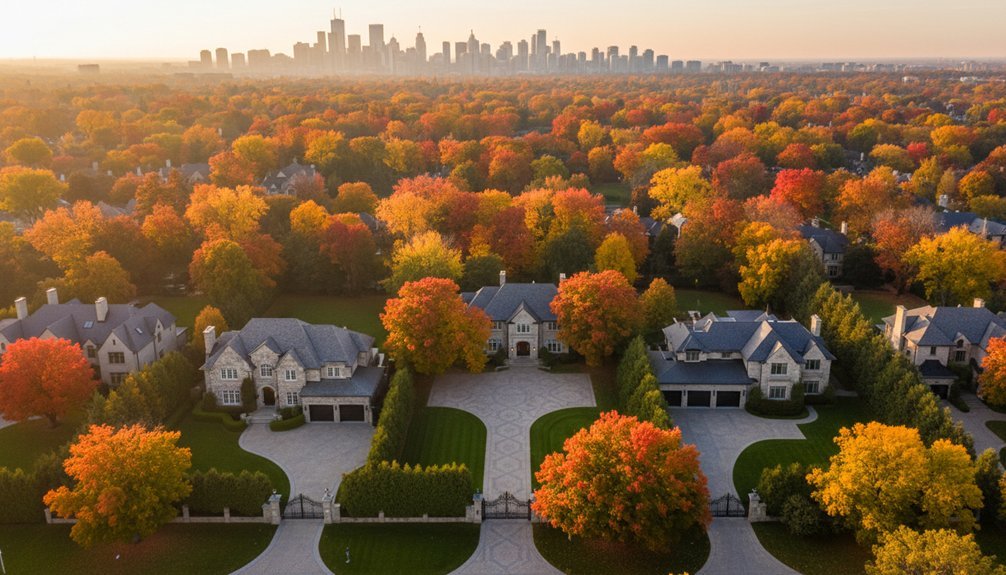
When measuring York Mills against Toronto’s most prestigious neighbourhoods, three elite enclaves dominate the conversation.
Forest Hill sits centrally with tree-lined streets and direct Allen Expressway access. You’ll find Upper Canada College, Bishop Strachan School, and Toronto French School here. The neighbourhood features stately mansions, upscale Forest Hill Village boutiques, and parks like Cedarvale and the Kay Gardner Beltline Trail.
Rosedale offers downtown proximity with the Rosedale Golf Club and Toronto Lawn Tennis Club. Properties showcase intricate stonework, marble flooring, and custom millwork. You’re minutes from Yorkville’s world-class shopping and Edwards Gardens’ botanical trails.
York Mills forms part of St. Andrew-Windfields in North York, near Hoggs Hollow. All three neighbourhoods consistently rank among Toronto’s top five luxury areas.
Each enclave delivers distinct advantages: Forest Hill provides central location, Rosedale offers old-city prestige, and York Mills combines North York space with established value retention.
From Farmland to Luxury Enclave: The History Behind York Mills
Samuel Heron’s 1804 grist mill launched what would become Toronto’s York Mills neighbourhood. James Hogg purchased the Arnold Mills property in 1824, establishing the York Mills name that persists today.
The community’s transformation followed distinct phases:
Industrial Era (1804-1926)
- Mills along Don River drove economic activity
- York Mills Hotel constructed in 1857, still standing
- Operations ceased by 1926
Suburban Shift (1911-1930s)
- British developers purchased Mulholland, Wood, and Armour farms in 1911
- Grand residences replaced industrial sites
- Affluent buyers sought historical character
Modern Infrastructure (1944-1974)
- R.E. Edwards developed Edwards Gardens in 1944
- E.P. Taylor donated parkland and mansion
- Highway 401 completed 1952-1956
- York Mills subway station opened March 1974
You’ll notice the 1856 subdivision remained largely undeveloped for a century—patience that created today’s spacious lots and established property values.
Conclusion
You’ve seen the data: 150% appreciation, sub-40 inventory, top-tier schools, and ravine access. York Mills’ Golden Triangle isn’t speculation—it’s geographic scarcity meeting institutional demand. You’re buying finite land between Highway 401 and the Don Valley, anchored by Earl Haig and York Mills Collegiate. Families compete for these lots because alternatives like Rosedale and Forest Hill can’t match the commute-green space-school trifecta. You’ll pay premium prices here. The triangle’s fundamentals explain why.